✺ The context
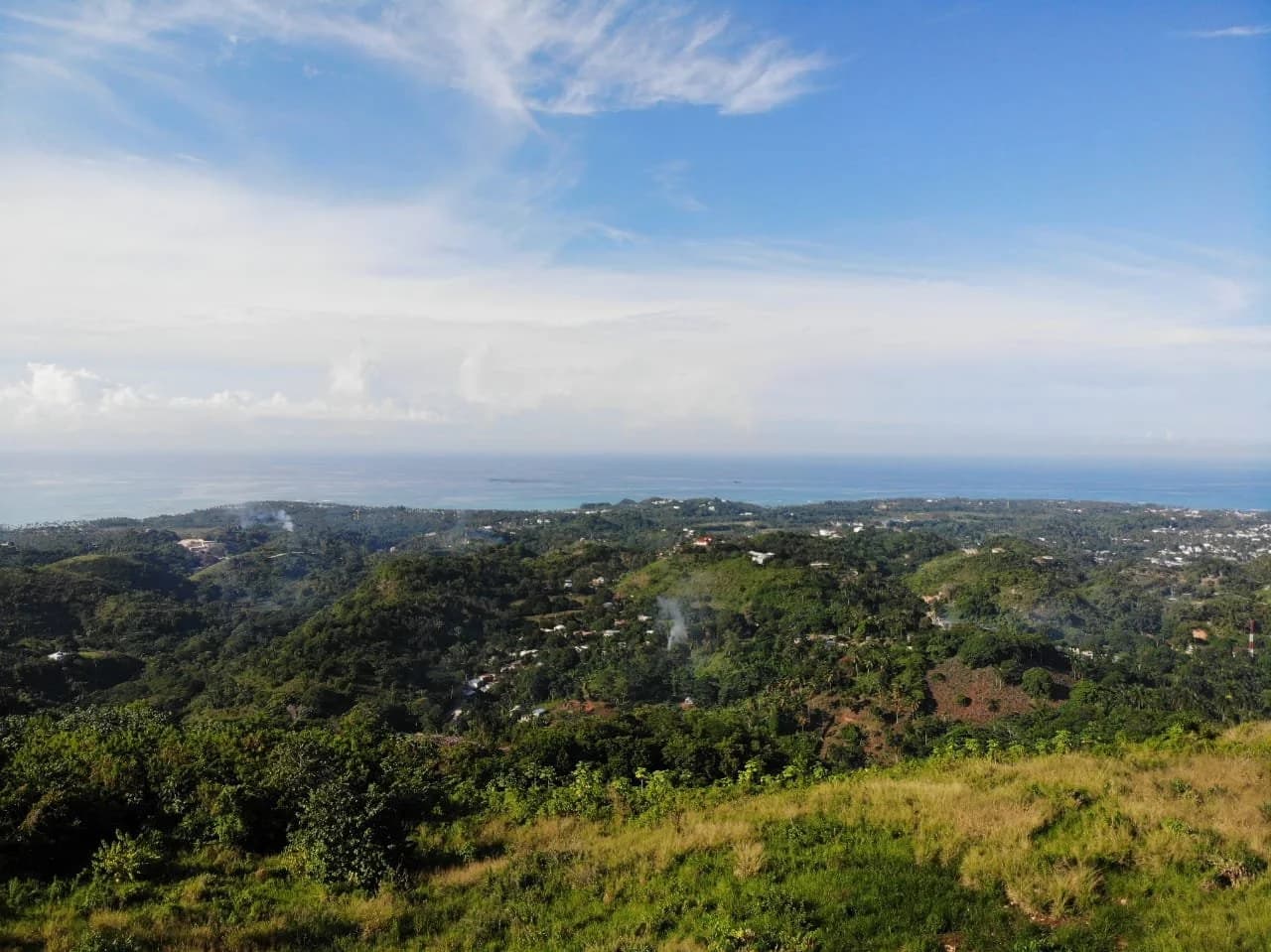
Las Terrenas is growing. Its young people are left on the shore.
Dominican tourism grew 5.2% a year for a decade. That growth, on its own, never reached the town’s young people. The data explains why.
Growth that does not spread
Anyone visiting Las Terrenas today sees construction, new hotels, restaurants full in season. Anyone who lives here sees something else: the same young people as always, waiting for an opportunity that passes them by.
Both pictures are true at once, and there is a documented explanation.
Between 2009 and 2018, tourism and services drove average economic growth of 5.2% a year in the Dominican Republic. The same analysis that records that figure — an education risk assessment commissioned by USAID in 2019 — notes that these activities do not require highly skilled labour. Translated: the sector grows by hiring cheaply, and growth on its own lifts neither the wages nor the careers of local people.
Growth is not the problem. The absence of a bridge to it is.
What the education numbers say
The same study sketches our students' starting point.
55%
- Share of those who start kindergarten and go on to finish secondary school.
65%
- Ceiling on secondary-level coverage, against a Latin American average of 76%.
38,604
- Adolescents out of school at secondary level nationally.
58.7%
- Of the boys who leave school do so in order to work, in informal jobs, and never return.
19%
- Of primary pupils are over-age — some 239,000 children. 74% of them have considered dropping out.
Source: USAID, Rapid Education and Risk Analysis — Dominican Republic, June 2019.
These figures explain a design decision that sometimes surprises people: in our basic-knowledge phase we teach Spanish — reading and writing — alongside English, maths and computing. It is not decoration. Some of our students arrive struggling to read, and our own selection process is built so that it does not exclude anyone who cannot fill in a written form.
Two failures, not one
What we see in Las Terrenas separates into two distinct problems.
Getting the job: without technical training there is no way into a sector that, paradoxically, hires all year round.
Keeping it: someone who starts without professional habits, without stress management or communication tools, leaves within months. And an early exit costs twice, because it leaves the young person where they started and confirms the employer's prejudice about hiring locally.
On top of that sits a third element, harder to measure: disengagement. Young people with no project of their own, no picture of their own future to sustain a job for.
Which is why the programme has the shape it has
Each piece answers one of those failures.
No technical skills
- 12 weeks of training in one of three specialisations.
No provable experience
- Real work-study: 3 days in a company, 2 days in class.
No academic base
- Spanish, English, maths and computing from week 1.
No soft skills
- A whole phase: punctuality, communication, stress, teamwork.
No project of their own
- The life project, with one-to-one sessions.
No network
- More than 15 partner companies and support after graduation.
All of it free for the selected student, in groups of no more than 12, inside facilities where the practice happens with real guests and real customers.
What we are measuring
We set explicit targets and assess them cohort after cohort: 90% graduation, 90% into work or self-employment, 95% of students placed in work-study, 75% registered in the alumni system, and attendance at the 6- and 12-month follow-up meetings.
We publish these targets because a foundation that only tells pretty stories cannot correct itself. After each cohort, students evaluate the training and the team decides what to change.
How to help
The figures above describe a structural problem. Our answer is deliberately small and concrete: 108 young people a year, one at a time, in a single town.
Businesses in Las Terrenas
- Take on interns, or teach in your own speciality.
Institutions and foundations
- The logical framework, the indicators and the sources are available for any serious funding conversation.
Individuals
- USD 500 covers a little over half a student's scholarship; a place costs about USD 920 for the 12 weeks.