✺ How we train
Your life project: the question we ask before any other
Before we teach you to cook, to welcome guests or to guide a tour, we ask you a harder question: what do you want from your life?
Before we teach you to cook, we ask you something else
Most courses start with technique. We start with you.
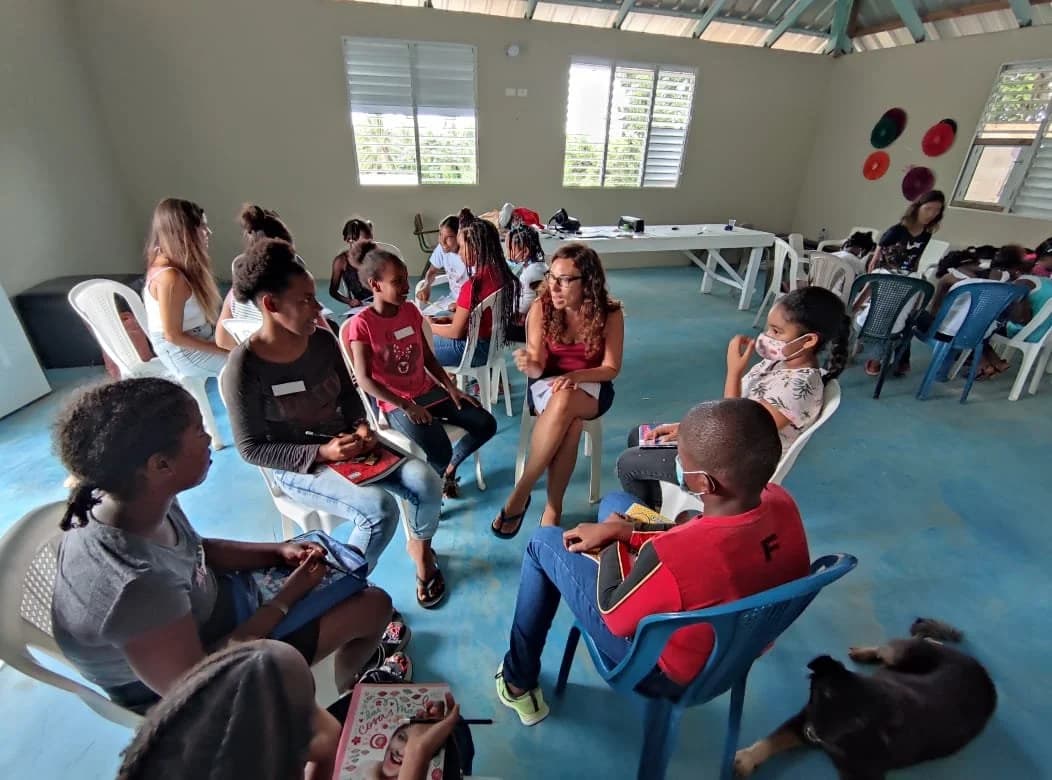
In the first week of the programme, every student sits down with us — not as a group, but one to one — to work on something we call their life project. It is not an exam. There are no right answers. It is a conversation about what you want your life to look like in five years, and about the steps it takes to get there.
That conversation is the reason this foundation is called La Fábrica de Sueños — the dream factory.
A life project is not a job
They are easy to confuse. A job is what you do on Monday morning. A life project is where that job is taking you.
It might be becoming an excellent, well-known bartender. It might be owning your own restaurant in Las Terrenas. It might be protecting the nature of Samaná by building tourism that does not destroy it. It might simply be becoming the first person in your family with a formal, stable job.
All of those are valid life projects. What does not work is having none: without a destination, every job feels equally temporary, and the first serious problem at work becomes a reason to leave.
Why we give it real time
We could spend those hours on more kitchen practice. We do not, and there is a reason.
When we look at why young people in Las Terrenas are left out of the tourism boom, we find two distinct problems, not one:
Getting the job
- Without technical training, there is no way into the sector.
Keeping it
- Those who do get in often leave within a few months.
The second problem is the less obvious one and the more expensive. It is solved with habits, communication, stress management and professionalism — what we call soft skills — but above all with a personal reason to get through the hard days. That reason is the life project.
How we work on yours
- At least two one-to-one sessions during the programme, and more if you need them
- One hour a week of the timetable set aside to support it
- An integration day at the start: sport, a meal outside Sienna, a hike
- Activities and workshops to find what you are good at, not only what you like
- Your project is not filed away at graduation: we revisit it during follow-up
Groups are capped at 12 students per specialisation. That limit exists precisely so this support is possible and not an empty promise.
You do not need the answer today
Many students arrive without knowing what they want. Some arrive certain about one thing and end up choosing another after meeting all three specialisations in the first weeks. Both are normal.
All we ask to begin is what we always ask: be between 18 and 22, live in Las Terrenas, and be willing to commit twelve weeks.
The question itself, we work through together.